
XDI launches Automated Resilience in the XDI Climate Risk Hub. Here's why it matters.

A portfolio of assets. Limited adaptation capital. Where do you start?
Asset owners, asset managers and investors can now confidently assess large portfolios against multiple climate hazards and scenarios, identify where risk is concentrated and estimate the potential financial consequences.
But knowing where risk is concentrated doesn’t tell asset owners and managers where to invest to reduce it, or where targeted adaptation capital could deliver the greatest reduction in risk and protect the most value.
Asset owners and managers responsible for large asset portfolios cannot realistically begin by commissioning detailed engineering assessments and adaptation plans for every high-risk property. Time, technical expertise and capital are limited.
And starting with the assets showing the highest risk won’t necessarily identify where adaptation can make the biggest difference.
Risk metrics tell you where the problem is greatest. They don’t tell you where adaptation will have the greatest material impact.
Risk and the opportunity to reduce it are not the same thing
Two assets can have similar levels of physical climate risk but very different potential to reduce it.
For one, relatively achievable changes to its resilience characteristics may materially reduce future damage from climate change. For another, a large proportion of the risk may be driven by factors that are difficult to change at the asset level, such as its location.
That distinction matters when deciding where to spend money on resilience.
Detailed engineering analysis, intervention design and costing remain essential to adaptation planning. But at portfolio scale, there is an important step that should come first:
Before committing time and money to detailed asset-level analysis, identify where adaptation could have the greatest impact.
This changes the starting point for resilience planning.
Instead of asking what could be done to every individual asset, asset owners and managers can first screen across the portfolio to identify where changes in resilience could materially alter the risk outcome. Those assets can then be prioritised for deeper investigation.
In other words: screen, identify, prioritise, escalate.
Put a value on the losses you could avoid
Prioritisation also requires more than knowing that an asset can become more resilient.
For asset owners and managers, this is ultimately a capital allocation decision.
How much financial risk could potentially be avoided? How much value could be protected? And what does that tell you about how much it may be worth investing in resilience?
The cost of an intervention is only one side of the equation. The other is the potential financial loss it could prevent.
The financial value of resilience lies in the losses you can avoid.
Understanding that value can help asset owners and managers build the business case for adaptation: comparing the potential cost of intervention with the value it could protect.
It can also help investors investigate the resilience of assets they own or are considering acquiring; insurers focus risk-management conversations; and banks identify where borrower engagement or adaptation finance may help protect collateral value, insurability and loan performance.
Bringing a portfolio lens to adaptation
This is the problem we set out to address with Automated Resilience, a new capability within the XDI Climate Risk Hub.
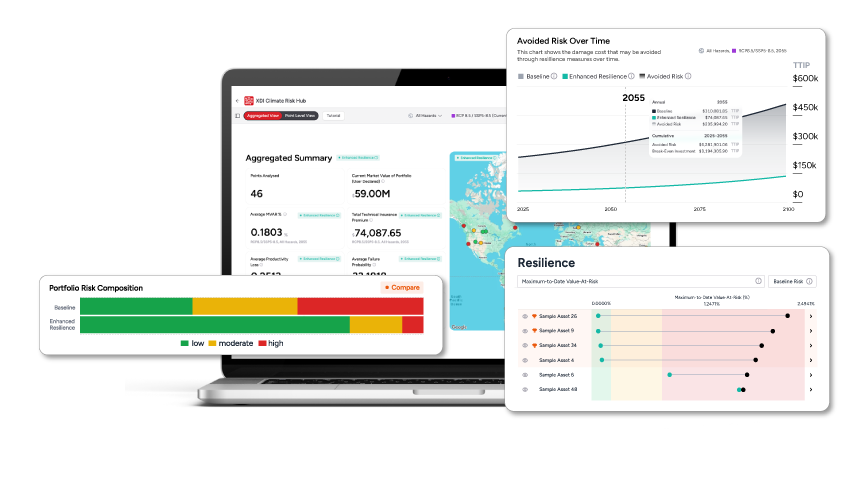
Automated Resilience automatically compares standardised resilience pathways for every eligible asset across a portfolio, revealing how sensitive each asset’s physical climate risk is to plausible changes in its resilience characteristics.
Rather than requiring users to configure and test individual interventions asset by asset, it provides an initial portfolio-wide screen and rapidly identifies where resilience could make the greatest difference.
New indicators including Adaptive Potential, Avoided Risk Value and Break-Even Investment allow users to compare resilience opportunities not just by the potential reduction in physical risk, but by their potential financial significance.
Break-Even Investment, for example, provides an indication of how much could theoretically be invested in resilience before the cost of adaptation exceeds the value of the modelled risk reduction. This provides an early indication of the financial viability of adaptation before detailed cost benefit analysis can be conducted
The purpose isn’t to replace detailed engineering investigation.
It’s to help asset owners and managers narrow the field and focus effort on those assets where resilience intervention is likely to matter most
From there, XDI can take the analysis deeper - investigating individual assets, testing specific adaptation measures and helping asset owners and managers understand how different interventions could change future risk and financial outcomes.
Don’t just quantify risk. Quantify the opportunity to reduce it.
Explore Automated Resilience in the XDI Climate Risk Hub.

Contact us
Get in touch with one of our friendly team

Sales
Get expert advice on the best solutions for your climate risk scenarios

Help & Support
Support and help for our customers
Get support
Complete the form so we can connect you to the right specialist to support your distinct needs.


Media & Press
Fill in the form to get in touch with our media team
Contact our media team
We have an experienced communication and media team that can assist with media enquiries.