
XDI launches Automated Resilience to prioritise adaptation investment across entire portfolios

New XDI Climate Risk Hub capability reveals where adaptation could reduce risk most
XDI (Cross Dependency Analysis) has today launched Automated Resilience, a new capability in the XDI Climate Risk Hub designed to help asset owners, asset managers and investors identify where adaptation could make the greatest difference across large portfolios.
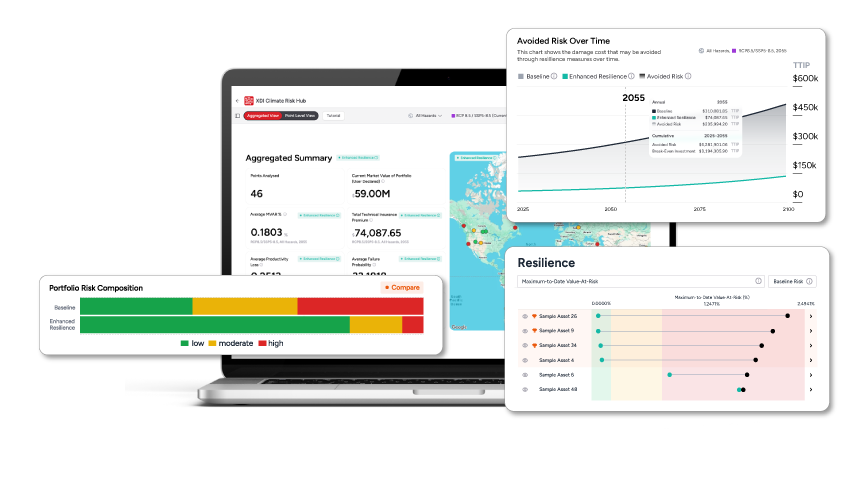
Physical climate risk analysis can show where risk is concentrated and estimate its potential financial consequences. But the assets with the highest risk are not always where adaptation will deliver the greatest results. Automated Resilience adds a portfolio-wide screening step, allowing users to compare baseline and enhanced resilience outcomes before committing time, expertise and capital to detailed asset-level investigation.
The capability automatically applies standardised resilience assumptions across eligible assets, helping users identify where physical climate risk could potentially be reduced and develop a prioritised shortlist for deeper technical assessment, due diligence and resilience planning.
“Most asset owners can now identify where climate risk is concentrated. The harder question is where limited resilience capital can make the biggest difference.
Automated Resilience gives users a portfolio-wide view before they commit time and money to detailed analysis of individual assets. It helps turn climate risk analysis into a starting point for action.”
— Dr Karl Mallon, CEO, XDI.
From identifying risk to prioritising resilience
Automated Resilience introduces new indicators that allow users to compare resilience opportunities by both the potential reduction in physical risk and its financial significance:
- Adaptive Potential: how much an asset's physical climate risk could potentially be reduced through adaptation.
- Avoided Risk Value: the estimated financial value of the damage costs that could be avoided.
- Break-Even Investment: an indication of how much could theoretically be invested before the cost exceeds the value of the modelled risk reduction.
Automated Resilience does not recommend specific interventions or replace detailed engineering analysis. Instead, it acts as an evidence-based triage layer, helping users focus deeper work on the assets where resilience measures may have the greatest impact.
Clients see a genuine business need
Clients who tested Automated Resilience highlighted its potential to support resilience planning, focus deeper analysis and investment, and strengthen the case for action. XDI client Climate Matters highlighted the capability's potential to complement climate risk assessment and adaptation planning undertaken in line with ISO 14091 and ISO 14090, particularly for clients managing multiple assets.
"For clients with multiple assets, we can see Automated Resilience complementing the climate risk assessments and adaptation planning we undertake in line with ISO 14091 and ISO 14090. It can help identify assets with both high risk and high adaptive potential, focusing deeper analysis and investment where they may deliver the greatest benefit. Its financial metrics can also help clients understand the potential value of resilience and strengthen the case for action.”
— Climate Matters
Available now in the XDI Climate Risk Hub
Automated Resilience is available now and is currently free for XDI Climate Risk Hub users.
Contact us
Get in touch with one of our friendly team

Sales
Get expert advice on the best solutions for your climate risk scenarios

Help & Support
Support and help for our customers
Get support
Complete the form so we can connect you to the right specialist to support your distinct needs.


Media & Press
Fill in the form to get in touch with our media team
Contact our media team
We have an experienced communication and media team that can assist with media enquiries.